

Wood vinegar, also known as pyroligneous acid, is a reddish-brown aqueous liquid with a distinctive smoky aroma and sour taste, carrying a pH value between 1.5 and 3.7, and a specific gravity generally greater than 1.005. It is a liquid biomaterial produced through the thermo-pyrolysis of woody biomass, containing various organic compounds, including acetic acid, methanol and esters, which contribute to its distinctive properties and wide range of applications.
Wood vinegar’s versatility and sustainability appeal to modern farmers. Composed of a complex mixture of organic acids, phenols, and other compounds, it has been studied for its ability to improve soil health, stimulate plant growth, and increase crop yields with the potential to promote environmentally friendly agricultural practices and mitigate the negative impacts of chemical fertilizers and pesticides. Wood vinegar also has the advantage of being a recycled material that can be used effectively in organic agriculture, unlike synthetic pesticides that are prohibited in such systems, and its price is only about one-third that of synthetic fungicides.
At Qlean Tech, wood vinegar is produced through advanced pyrolysis of organic biomass and offered as a safe, natural farm input, helping growers reduce reliance on chemicals and build healthier ecosystems.
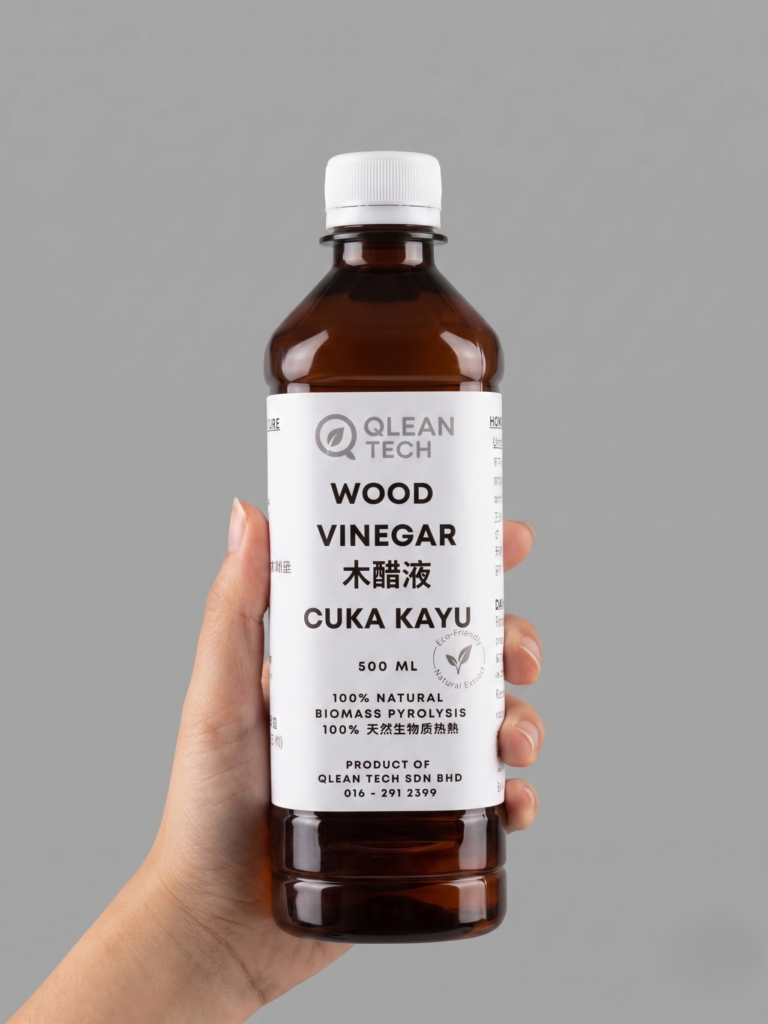
Qlean Tech produces high-quality wood vinegar through biomass pyrolysis, offering a natural solution for sustainable agricultural applications.
How Is Wood Vinegar Produced?
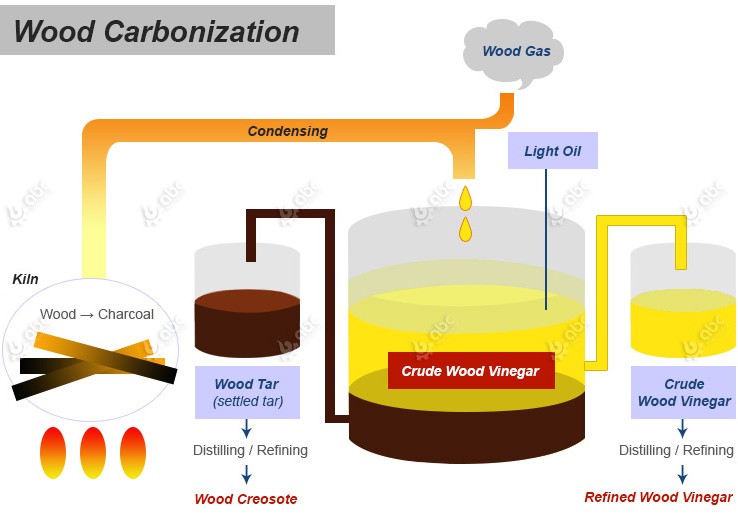
Source: ABC Machinery
Wood vinegar is produced through pyrolysis, a thermal decomposition process in which organic biomass such as wood, rice husks, or agricultural residues is heated at high temperatures in an oxygen-limited environment. Slow pyrolysis occurs at a relatively low heating temperature of approximately 400°C with a long solids residence time, resulting in secondary cracking of primary products. This approach is particularly effective for producing wood vinegar as a primary by-product alongside biochar. During the carbonization process, the raw material is heated in an oxygen-free environment, releasing volatile matter from the parent material, and producing three phases of output: charcoal, liquid products, and fuel gas. Wood vinegar is then clarified from the liquid products. Peak wood vinegar yield typically occurs within the 310 to 330°C temperature range.
Once collected, the raw liquid undergoes refinement to remove tar and other impurities. It is then stored in a closed container for at least three months and decanted to separate sedimentation tar from the bio-oil, resulting in a transparent upper-phase solution known as practical wood vinegar. Feedstock type, heating rate, temperature, and production technology are all important factors that influence the final properties of the wood vinegar produced.
At Qlean Tech, this process is carried out using advanced pyrolysis systems designed for consistency and quality, ensuring the wood vinegar delivered to farmers is safe, stable, and effective.
Fun Fact: Wood Vinegar Is Made from Condensed Smoke
Here’s something most people don’t know — the wood vinegar used in farming is essentially captured smoke. During the pyrolysis and carbonization of agricultural and forestry biomass to produce biochar, the brown liquid produced by condensation reflux is known as wood vinegar. The carbonization smoke, made up of gases and vapors released during the thermal decomposition of wood in a low-oxygen environment, is passed through a condensation device, where part of the smoke gases condense and are collected. After a settling process lasting from weeks to months, two phases separate: an oily fraction at the bottom known as wood tar, and the supernatant aqueous phase, which is the raw wood vinegar. After refinement, what remains is a reddish-brown liquid containing more than 300 organic compounds, ready for agricultural use.
What makes this even more remarkable is that the same smoke once simply released into the air during traditional charcoal making can now be captured and put to use. Liquid smoke is known by several names such as smoke flavoring, smoke condensate, wood vinegar, and pyroligneous acid. Its applications span agriculture as a fertilizer, pesticide, and growth-promoting agent, while it also serves as a source of bioactive compounds mainly derived from lignin. The resulting gases are condensed in an external tank into an amber liquid, rich in over 300 compounds including polyphenols, organic acids, esters, and ketones, all from what was once considered waste smoke.
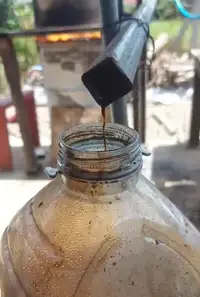
Source: ECHO Community
Why Product Quality and Production Process Matter
Not all wood vinegar is created equal. Wood vinegar’s quality parameters include
pH value of around 3.0
specific gravity of approximately 1.010–1.050
a pale yellow, bright brown, or reddish brown color
a smoky odor
dissolved tar concentration of no more than 3%
transparency without suspended solid matter.
These standards exist for good reason. Crude wood vinegar contains chemical components that are easily oxidized, polymerized, and prone to color change, making its properties unstable. In addition, oily wood tar mixed in during extraction may adhere to or precipitate within the product. In short, poorly processed wood vinegar can do more harm than good.
Refining is what distinguishes an effective agricultural input from a hazardous one. Raw wood vinegar may contain harmful chemicals such as polycyclic aromatic hydrocarbons (PAHs) and volatile organic compounds, such as acetaldehyde, acetone, ethylene glycol, and methanol. However, these can be effectively removed through sequential refining procedures, resulting in a purified product suitable for agricultural and animal husbandry applications. The composition of wood vinegar varies according to the biomass used, pyrolysis process, refining procedures, and storage conditions, which is why standardized and controlled production is essential.
Benefits of Wood Vinegar in Agriculture
Wood vinegar’s wide-ranging chemical composition makes it one of the most versatile natural inputs available to modern farmers today.
Enhances plant growth
Wood vinegar contains both acids and phenols, which have high biological activity. After entering leaf tissue, they stimulate cell activity, thus increasing the plant’s overall vitality.
Wood vinegar promotes seed germination, enhances seedling vigor, supports vegetative and reproductive growth, and bolsters resistance to both biotic and abiotic stresses, which contributes to increased crop yields.
Applying wood vinegar also increases crop biomass by increasing leaf area and the number of pods per plant, while enhancing tolerance under low-temperature stress.
When applied in diluted form as a foliar spray or soil drench, wood vinegar may support stronger root development and healthier leaf growth. Research also suggests it can improve crop-quality traits, such as fruit soluble solids and grain quality, beyond simply promoting growth.
Natural pest control
Wood vinegar has been recognized as a safe, natural inhibitor with various bioactivities, making it suitable for antifungal, termiticidal, and repellent uses.
The pesticidal effects of wood vinegar produced with mixed material have shown mortality rates of more than 90% for treated aphids and mites, while in Thailand it caused approximately 95% mortality in aphid populations on eggplant.
Wood vinegar could be used as a natural and organic agricultural input to help manage not only pests, bacterial and fungal diseases, but also against emerging oomycete plant diseases.
Boosts soil fertility
Wood vinegar application has been found to increase soil organic matter content, improve nutrient uptake by plants, and encourage beneficial microbial populations.
Wood vinegar treatments of increasing concentrations significantly increased the quantity of bacteria in soils, resulting in a significant increase in the total quantity of microbes.
Wood vinegar improves soil conditions, supports the microbiota, and invigorates soil organisms. A study by Food Energy Security shows that despite a temporary decrease in pH shortly after application, the original pH value is gradually restored with no long-term adverse effects.
Odor reduction and composting
The combination of biochar and wood vinegar has been shown to reduce greenhouse gas emissions by 61.9%, decrease nitrogen loss by 35.8%, and reduce carbon loss by 15.5% during manure composting.
Wood vinegar mixed with biochar and zeolite can reduce ammonia loss by 64–74% and decrease carbon dioxide, methane, and nitrous oxide emissions by 34–81% during composting.
The combined use of biochar and wood vinegar significantly improves compost quality and reduces ammonia emissions, offering a promising solution for sustainable agricultural residue management.
Wood vinegar has been studied for odour control in livestock and manure systems. Its acidic and bioactive compounds may help reduce offensive manure odours, especially where ammonia emissions are a concern.
In composting systems, wood vinegar may act as a compost activator by influencing microbial activity and improving the breakdown of organic materials. At lower concentrations, it may also support faster composting and better nutrient retention.
Eco-friendly and sustainable
Wood vinegar has emerged as an eco-friendly alternative that can play a key role in promoting plant health while reducing environmental impacts.
Wood vinegar represents a sustainable and eco-friendly alternative to conventional chemical fungicides, while also supporting the more favorable development of biomass pyrolysis as a production method for the optimal use of agricultural and forestry waste.
The negative effects of synthetic fungicides on the environment and human health have prompted the increasing use of biofungicides as alternatives, with wood vinegar emerging as a high-value, widely applicable option in integrated plant disease management.
Other Applications of Wood Vinegar
Wood vinegar’s versatility makes it applicable across multiple areas of farming and land management. Due to its acidic nature and the presence of abundant bioactive compounds such as phenols and aldehydes, wood vinegar has been used in agriculture as a pretreatment agent, soil amendment, antimicrobial agent, and plant growth regulator. It has gained attention for its effects on plant growth, pest control, soil improvement, seed germination, root development, and disease suppression, and has proven effective against various insects including aphids, mites, and mosquitoes. When applied at low doses it functions as a foliar or soil fertilizer, while at high doses it can serve as a natural herbicide, providing farmers with a flexible, concentration-dependent tool with multiple use cases in a single product.
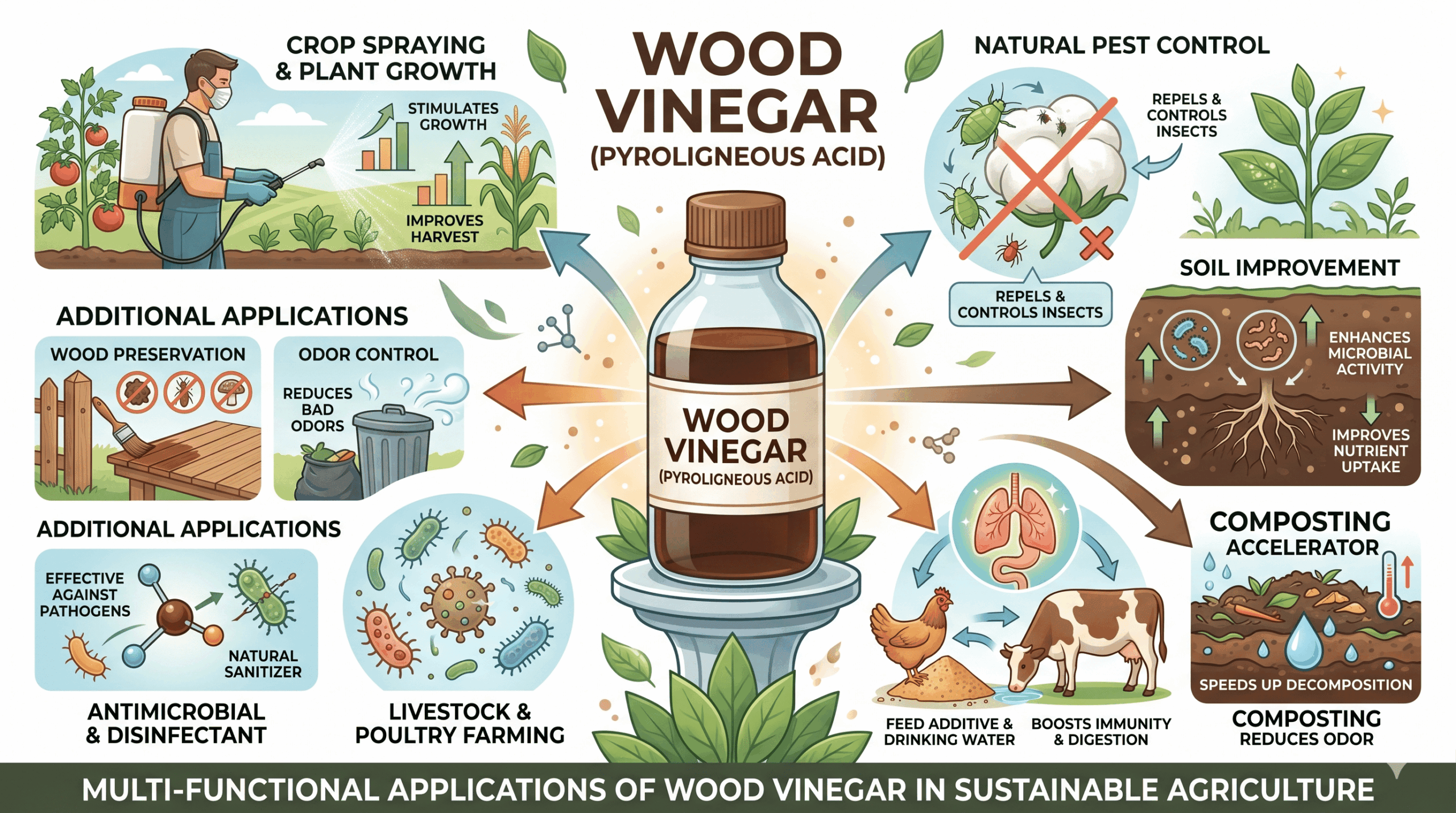
One of the most practical advantages of wood vinegar is how easily it integrates into existing farm routines. In field trials, wood vinegar has been applied alongside standard NPK fertilizers, sprayed directly onto crops to enhance results while reducing overall chemical dependency. It can also be incorporated into insecticide sprays as a natural complement, helping to boost pest control efficacy while reducing the amount of synthetic chemicals required per application. Wood vinegar has also been studied as a promising natural antimicrobial alternative in animal husbandry with research showing it can improve growth performance, support intestinal health, and reduce the need for conventional antibiotics in livestock and poultry farming. In composting, wood vinegar has been shown to enhance the decomposition of organic matter and accelerate the breakdown of agricultural residues such as straw, improving nutrient content and reducing decomposition time.
Beyond agriculture, wood vinegar has also attracted interest in non-agricultural applications such as wood preservation, odor control, animal husbandry, textile dyeing, and selected eco-product uses. Its natural antimicrobial and preservative properties have led to growing interest in hygiene-focused and biomass-based applications, while research has also highlighted its potential activity against certain bacteria and fungi such as, E. coli and Listeria monocytogenes, and Aspergillus niger. This broader relevance shows that wood vinegar is not only an agricultural input, but also a versatile biomass-derived solution with wider commercial potential.
Frequently Asked Questions (FAQs)
What is wood vinegar?
Wood vinegar, also known as pyroligneous acid, is a reddish-brown liquid produced through the thermo-pyrolysis of woody biomass, containing organic compounds that give it its distinctive smoky properties and wide range of agricultural uses.
What is wood vinegar used for in agriculture?
Wood vinegar is commonly used in agriculture to support plant growth, improve soil condition, help manage pests, reduce odor, and enhance composting. Depending on the dilution rate and application method, it can be used as a foliar spray, soil treatment, composting aid, or sprayed together with insecticides in certain agricultural applications.
Can wood vinegar be used beyond agriculture?
Yes. Beyond agriculture, wood vinegar has also attracted interest in areas such as wood preservation, odor control, animal husbandry, textile dyeing, and selected eco-product applications. Its natural antimicrobial and preservative properties give it wider potential beyond farm use.
Is wood vinegar safe for crops and soil?
Properly refined wood vinegar and correct application are important for safe agricultural use. When produced under controlled conditions and used at the recommended dilution, wood vinegar can be applied to crops and soil as part of sustainable farm management.
How should wood vinegar be applied?
Wood vinegar is typically diluted with water before use. It may be applied as a foliar spray, soil drench, or compost additive, depending on the intended purpose. Application rate and dilution should always follow the supplier’s guidance for the specific crop or use case. For general foliar spray: mixing 50ml to 200ml to every 18L spray tank is a common starting point.
What packaging sizes are available?
Wood vinegar is available in several packaging sizes to suit different users, including:
- 500ml
- 20L jerry can
- 1000L IBC tank
This gives flexibility for home growers, small farms, and commercial agricultural users.
How much does wood vinegar cost?
The price depends on packaging size and order volume. Typical price ranges are:
- 500ml: around RM3.80
- 20L jerry can: around RM35 to RM60
- 1000L IBC tank: around RM1,500 to RM2,200
Prices may vary depending on quantity, location, and current promotions.
How should wood vinegar be stored?
Wood vinegar should be stored in a tightly closed container in a cool, dry place away from direct sunlight and contamination. Proper storage helps maintain product stability and quality over time.
Why does wood vinegar quality matter?
Wood vinegar quality matters because poorly refined products may contain tar and unstable compounds that affect safety and performance. At Qlean Tech, every batch goes through a controlled pyrolysis and refinement process to help ensure the wood vinegar is consistent, safe, and suitable for agricultural use.
Ready to Improve Your Farm Outputs with Natural Inputs?
Qlean Tech is dedicated to providing farmers with high-quality, sustainable solutions. Our advanced pyrolysis process ensures every batch of wood vinegar meets strict quality standards, offering you a safe, stable, and highly effective natural farm input.
Join the growing number of farmers who are already experiencing the benefits of Qlean Tech Wood Vinegar. Take the Next Step Towards Sustainable Farming.