

On this page
The result is a lightweight, porous material that's packed with carbon. Studies show that the carbon content of palm kernel shells nearly doubles through this process, jumping from about 46% in raw form to as high as 73% after pyrolysis. In simple terms, biochar takes carbon that would otherwise break down and release greenhouse gases, and locks it into a solid, stable form instead.
What makes PKS biochar especially valuable is just how long that carbon stays locked away. Research published by Journal of Oil Palm Research found that PKS biochar can remain stable in soil for over 100 years, meaning it doesn't just store carbon temporarily — it keeps it out of the atmosphere for generations. On a global scale, scientists estimate that biochar applied to soil systems could sequester between 0.7 and 1.8 billion tonnes of CO₂ equivalent per year. For businesses and farmers looking for a practical, proven way to reduce their carbon footprint, PKS biochar is one of the most accessible options available today.
In Malaysia, the term biochar is still relatively new in some industrial discussions. Depending on the application, buyers may also refer to similar materials using terms such as PKS carbon, palm kernel shell charcoal, or raw material for activated carbon production. For this reason, PKS biochar should not be viewed only as a soil-related product, but also as a practical carbon material with growing relevance for industrial and commercial use.
At Qlean Tech, PKS biochar is produced from locally available palm kernel shells, turning agricultural by-products into a practical carbon solution for agriculture and industry.
Why Palm Kernel Shell? Understanding the Feedstock Behind PKS Biochar
Not all biochar is created equal — the raw material (or "feedstock") used to make it plays a big role in determining the quality of the final product. Palm kernel shells stand out because of their natural makeup. PKS is composed of roughly 21–27% cellulose, 21–22% hemicellulose, and 44–50% lignin. That high lignin content is especially important as lignin is the tough, woody part of plant material that doesn't break down easily, and it's what allows PKS to produce a higher yield of biochar compared to other oil palm wastes like empty fruit bunches or oil palm fronds. In short, the shell's natural toughness is exactly what makes it ideal for creating a dense, carbon-rich biochar.

Beyond its composition, palm kernel shells are also incredibly abundant. Malaysia alone produced approximately 4.46 million tonnes of PKS in 2014, rising to 4.72 million tonnes by 2016, and those numbers have only grown since. For every tonne of crude palm oil produced, about 0.16 tonnes of PKS is used as boiler fuel in mills, while the remaining 0.20 tonnes per tonne of CPO is often underutilized or sold off as fuel. That's a massive amount of material that could be put to much better use. By converting this surplus into biochar, palm oil mills can turn a low-value byproduct into a high-value sustainable product, helping reduce waste and creating additional economic value.
Qlean Tech utilizes palm kernel shells as a reliable feedstock for producing PKS biochar with consistent quality and broad application potential.
Why Industry Players Prefer PKS Over Other Biochar Feedstocks
Biochar embodies the principles of the circular economy by transforming waste into long-lasting, high-value resources. Agricultural residues, forestry by-products, and organic waste streams are converted into value-added and environmentally friendly biochar materials that store carbon for the long term. At the same time, pyrolysis systems produce energy-rich by-products that can be reused for heat or power, forming closed-loop systems that maximise resource efficiency.
In agriculture, biochar not only stores carbon but also improves soil fertility, water retention, and nutrient availability, while supporting beneficial soil microbes. In industrial applications, biochar can replace carbon-intensive materials in cement, battery electrodes, and printing inks, helping reduce emissions while maintaining product performance.
By turning waste into a sustainable, low-carbon resource, biochar supports green industry, resource efficiency, and long-term environmental stewardship, aligning perfectly with Qlean Tech’s mission to deliver innovative and sustainable solutions. From agriculture to industry, biochar is a multi-purpose material that helps businesses and communities move toward a more sustainable, circular, and low-carbon future.
| Attribute | PKS Biochar | Coconut Biochar | Bamboo Charcoal | Wood Charcoal | EFB Biochar |
|---|---|---|---|---|---|
| Calorific Value | 16–20 MJ/kg | 18–21 MJ/kg | 18–20 MJ/kg | 14–18 MJ/kg | 12–15 MJ/kg |
| Carbon Content | High, consistent | Very high, consistent | High, variable | Moderate | Low |
| Supply | Abundant byproduct | Established shell feedstock, more limited supply in palm-based markets | Cultivated | Forestry waste | Abundant, bulky |
| Ash Content | Low moderate | Low | Low | Moderate | High |
| Applications | Energy, activated carbon, soil | Activated carbon, premium charcoal, adsorption applications | Cooking, activated carbon | Energy, soil | Compost, low-grade fuel |
| Sustainability | Waste valorization | Agricultural byproduct utilization | Renewable crop | Traditional | Waste utilization |
Overall, PKS is often preferred by industrial users because it offers a strong balance of carbon quality, practical energy value, supply consistency, and waste-to-value potential. While coconut shell remains a well-established benchmark for premium carbon applications, PKS is gaining attention as a more scalable and cost-practical alternative in palm-producing markets such as Malaysia.
Why PKS Biochar Is a Practical Choice in Malaysia
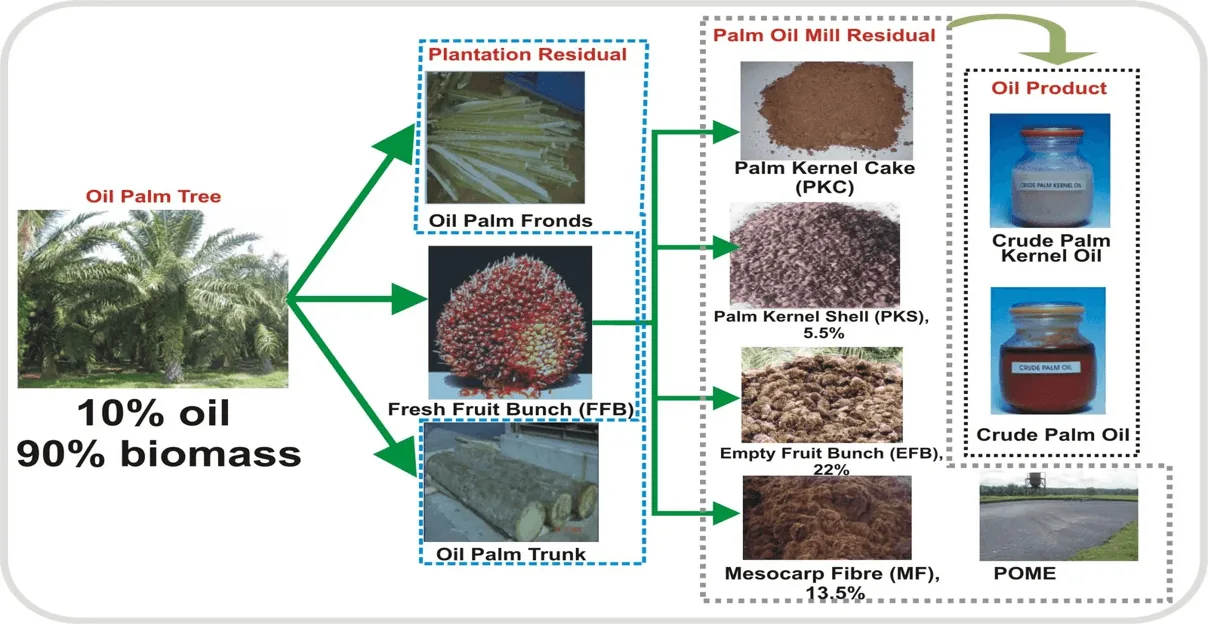
(Source: BioEnergy Consult)
Malaysia is one of the world’s largest palm oil producers, and with that comes a substantial volume of biomass residues. Only about 10% of the total output from palm oil production is actual oil, while the remaining 90% consists of by-products and biomass waste such as empty fruit bunches, mesocarp fiber, and palm kernel shell. By 2022, Malaysia’s palm oil industry was generating an estimated 182.6 million tonnes of waste annually. Rather than allowing these materials to remain underutilized, converting PKS into biochar offers a practical way to turn surplus biomass into a higher-value product that supports both agriculture and environmental goals.
This also aligns well with Malaysia’s broader sustainability direction. Malaysia has committed to achieving net-zero greenhouse gas emissions by 2050 and to reducing its economy-wide carbon intensity by 45% by 2030 against 2005 levels. Budget 2025 also highlighted biochar as an emerging solution for climate change and sustainable development, particularly in managing organic agricultural waste. In addition, a study published in Science of the Total Environment found that utilizing available agricultural feedstocks for biochar in Malaysia could remove 6 to 12.4 million tonnes of CO₂ annually, potentially reducing the country’s agricultural emissions by up to 54%. As Malaysia advances its decarbonization and carbon-pricing agenda, PKS biochar stands out as a practical product that fits the country’s transition toward a more circular and low-carbon economy.
How Is PKS Biochar Produced?
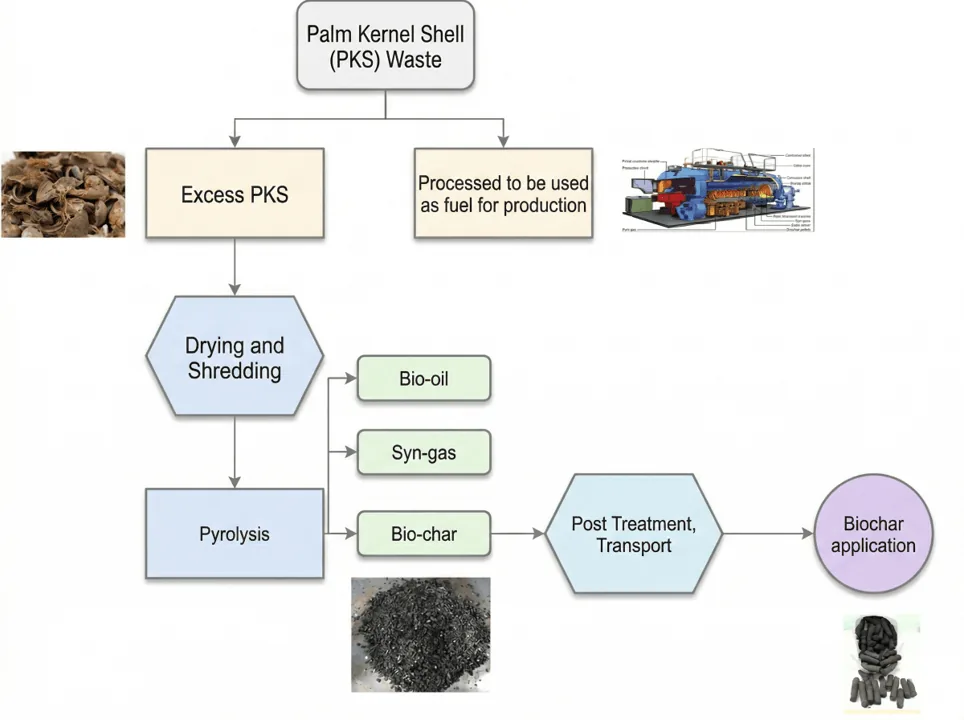
The production of PKS biochar relies on a controlled heating process known as pyrolysis. In this process, palm kernel shells are placed in a sealed reactor and exposed to high temperatures in an oxygen-limited environment. Without enough oxygen to support full combustion, the shells do not burn into ash. Instead, they gradually transform into a dense, carbon-rich solid. The ideal temperature range for producing PKS biochar is between 400°C and 600°C, with residence times of 30 to 60 minutes. During pyrolysis, the shells produce not only biochar but also bio-oil and pyrolysis gases, or syngas, with biochar accounting for roughly 33% to 52% of the total output depending on temperature and duration. The syngas produced can even be recycled to fuel the pyrolysis system itself, helping make the overall process more energy-efficient.
What happens inside the shell during pyrolysis is a step-by-step breakdown of its natural components. First, moisture evaporates at lower temperatures of up to around 140°C. Next, hemicellulose begins to decompose at about 298°C, followed by cellulose at around 340°C. Finally, lignin, the most resistant component, breaks down at higher temperatures around 560°C and completes its transformation into biochar at approximately 610°C. In general, higher temperatures produce a more carbon-dense and stable biochar, although the overall yield decreases. This is why temperature control is so important: it is a balance between maximizing biochar yield and ensuring high quality with strong carbon stability for long-term use.
Benefits of PKS Biochar
PKS biochar offers a wide range of advantages across agriculture, environment, and industry. Here are some of the key benefits worth knowing.
Improves Soil Health and Crop Yield
PKS biochar's porous structure significantly improves water holding capacity. Research found that this increased from 2.23 g to 6.21 g of water per 10 g of material after pyrolysis.
Better water and nutrient retention supports healthier soil and stronger plant growth. A large-scale global analysis published in PNAS also found that annual biochar application increases crop yields by an average of 10.8%, with benefits that persist and even grow over time.
A Natural Carbon Storage Solution
PKS biochar has been shown to function as an effective carbon sink with a half-life in soil exceeding 100 years. This means it can lock carbon away for generations rather than allowing it to return to the atmosphere.
In a Malaysian context, research estimates that biochar produced from agricultural feedstocks could remove 6 to 12.4 million tonnes of CO₂ annually, potentially reducing the country's agricultural emissions by up to 54%.
Reduces Waste and Supports Circular Economy
For every tonne of crude palm oil produced, around 0.20 tonnes of surplus PKS remains unused or is sold off as low-value fuel.
Converting this waste into biochar transforms it into a high-value product, reducing waste, lowering emissions from decomposition, and creating additional value for palm oil mills and businesses alike.
These benefits make Qlean Tech PKS biochar a practical option for businesses and growers looking for a more sustainable, carbon-smart material.
Common Applications of PKS Biochar
PKS biochar’s versatility makes it useful across a wide range of industries. In agriculture, it is most commonly used as a soil amendment. Its porous structure helps improve water retention, increase nutrient availability, and support better soil conditions, especially in acidic or low-fertility soils. It can also serve as a carrier for slow-release fertilizers, helping farmers reduce their dependence on chemical inputs over time. Beyond agriculture, PKS biochar and related PKS-derived carbon materials have also shown potential in water treatment, where their adsorption properties can help remove contaminants such as heavy metals from wastewater. Studies have also reported promising results in the treatment of palm oil mill effluent, including pollutant and color reduction.
On the industrial side, biochar is gaining traction in areas many people wouldn't expect. When added to concrete mixtures, biochar can reduce cement demand and lower the construction carbon footprint without compromising structural performance. In animal farming, biochar is used as a feed additive that supports animal growth, improves gut health, and even reduces methane production from livestock. Biochar is also increasingly relevant in carbon removal markets, where verified biochar projects can generate durable carbon removal certificates under recognized standards. Whether it is enriching soil, treating wastewater, supporting lower-carbon materials, or participating in carbon removal markets, PKS biochar is proving to be far more than just charcoal.
Why Choose Qlean Tech PKS Biochar?
When sourcing PKS biochar, product quality depends heavily on how it is produced. Qlean Tech combines production expertise with quality-focused processes to deliver PKS biochar that is consistent, practical, and suitable for a wide range of agricultural and industrial applications. Backed by in-house R&D capabilities and real-world production experience, Qlean Tech’s biochar is developed with close attention to feedstock quality, pyrolysis control, and end-use performance.
What also sets Qlean Tech apart is the range and flexibility of its biochar offerings. While PKS biochar is Qlean Tech’s main biochar product, other feedstock options such as coconut shell biochar, EFB pellet biochar, bamboo biochar, and wood biochar are also available to suit different application needs. Whether for soil improvement, carbon-focused initiatives, or bulk industrial use, Qlean Tech offers reliable biochar products for customers seeking dependable supply and practical application value.


